
Greetings from San Sebastián!
That’s a slightly more exotic opening than normal – I’ve been here on a reporting trip for a couple of days. (It might look, if you were tracking me, like an awful lot of that has involved eating pintxos and strolling along Playa de la Concha. But that is an illusion. These are crucial elements in the sort of gritty shoe-leather string-gathering in which I specialize.)
If you’ve been following the Copa del Rey, you’ll be able to guess the occasion: Real Sociedad hosted Athletic Club in the second leg of the Spanish cup semifinal last night. It’s a game I’ve always wanted to see for myself: a genuinely fierce local derby in which, extremely unusually, the fans sit together without segregation or heavy-handed policing. All of those pintxos have, um, helped me find out why. Yes. That’s it.
There was one other attraction, I’ll admit: the chance to watch two teams try to play football that did not, essentially, involve quite as much wrestling in the six-yard box as the average Premier League game just at the moment. That applies to pretty much every team in England, of course, but there is one that’s quite a lot better at it than everyone else, and that’s what I wanted to think about today.


Arsenal Aren’t Pretty To Watch. Does It Matter? 🫣

The concept of a team being Bad Champions is relatively new, as far as I can tell. It’s not an accusation that I remember being leveled at teams in the 1990s, when I was first inhaling as much football as was humanly possible. Even after the Premier League had become a global phenomenon and social media had polluted the atmosphere around it, the idea had not really entered the bloodstream.
That changed late in early 2021, when Liverpool found itself in an accelerating free fall. Jürgen Klopp’s team had finished the previous season as runaway league leaders, landing a first title for 30 years, but had struggled with first injury and then form.
Liverpool’s defense of the championship had been so flimsy that Roy Keane, a former Manchester United captain – this feels like it is probably quite relevant but we all have to pretend that it is not – decided that it called into question not just the side’s tactical acumen, footballing ability or collective resilience, but its moral character. “They are making a lot of excuses,” he said. “To me, they’ve been bad champions. It’s almost as if they won the league and got a bit carried away, believed their own hype.”
Keane has, it will be no surprise, made the same accusation this season, too. (Oddly, being Bad Champions is something that Keane only ever directs at Liverpool. It is literally impossible to think why.) It is a charge that aggravates me for reasons that extend beyond being a fan and into something broader: it represents, I think, a convenient and unfair moving of the goalposts.
In effect, it creates a secondary expectation: not only does a team have to win a title, they also have to carry themselves in a certain way after the event. (What that way is has not been made entirely clear, but the bar would appear to be set at remaining in the title race for some time.) That is not an absurd position to take, but it feels like an unfair one.
It is effectively saying that a side has to win the title not once, but twice; that the initial victory has to be followed by a stalwart defense or it is in some way diminished, illegitimized. It’s a form of time-delayed criticism, of disregarding an unpalatable past when the present is more favorable to an agenda. Winning the league has always been the ultimate riposte. This is a way of questioning it in retrospect.
Arsenal fans might like to deploy the same logic when they see their side, nine games away from claiming a first championship in 22 years, criticized for its style of play. True, the situations are not entirely analogous – nobody is trying to discredit Arsenal after the event – but the effect is largely the same: it creates the impression that Arsenal would somehow belong to a lesser order of champion.
To most people within football, that accusation would make very little sense. Mikel Arteta has been perfectly clear that he could not care less what the game’s commentary class thinks of how his team plays; there are no points for style, as the saying goes. He and his players are there to win a trophy. Any how can be justified as long as it delivers the desired outcome.
A lot of Arsenal fans would regard it as secondary, too, and by quite some distance. For more than 20 years, their club was a standard-bearer for the aesthetic; Arsène Wenger turned Arsenal into consistently the most stylish, the most watchable team in England. It did not, after 2004, deliver a single title. In the stands at the Emirates, there is an avowed belief that good football is winning football.
That is all as it should be. One of the fundamental tensions in the game, one that we do not really acknowledge enough, is that we are all in it for different things. For the players and their managers, it is a job. They are judged, in the end, on their output. Success is weighed in silver and gold. Everything else is a bonus, at best.
Their fans have a slightly different perspective. They do want to be entertained. The word “good” is not especially useful here; perhaps “exciting” is better: they want to see their team play exciting football. But their vision is impaired: not just because any game involving your club is inherently exciting on some level, but because there is nothing quite so exciting as winning.
Take a step further back, and things change again. It is here – among the neutrals and the not-so-neutrals – that there are, at least in a theoretical sense, points awarded for style. Admittedly, quite how those points are earned is opaque, at best. Not everyone enjoys the same type of football, after all: plenty of people claimed to find the great Barcelona sides of Pep Guardiola boring.
But it is true to say that most of us will rank champions not just in terms of what they achieve, but in how they achieve it. It is why Wenger’s Arsenal sides are remembered more fondly than José Mourinho’s Chelsea teams. It is why some of Alex Ferguson’s iterations of Manchester United inspire more nostalgia than others. It is why, in time, Klopp’s title-winning Liverpool may outstrip Arne Slot’s version.
And in that, Arsenal does fall short. Arteta’s team is not as slick, as smooth, as Guardiola’s best City teams. It does not play with quite the same verve as Wenger’s sides, or the thrilling bravado as Ferguson’s finest Uniteds. Watching Arsenal is kind of a grind, unless – and this is the key bit – you are an Arsenal fan.
Of course that criticism does not matter to the players or the staff. It should not matter to the fans. That it does is testament not only to the innate desire to protect your club from harm, but to a fundamental, experiential difference: what Arsenal fans watch, what they feel, when they are watching Arsenal is completely separate to what the rest of us see.
Language is, in this sort of thing, important. I would contest the idea that Liverpool were “bad champions.” I would not quibble in the slightest with the notion that they have been bad defending champions. (Although, you know, context.) A similar line can be drawn with Arsenal. Arteta has a great team, without question. That is different to being great to watch.
And that’s fine. It would not make their achievement any less meaningful, any less special. It might, admittedly, change the way they are remembered on the outside. But that is not how they will be remembered inside, by the players or the managers or the fans. What they will remember is the lifting of the trophy; that, to them, is all that will matter.
📬 Enjoying The Correspondent? Check Out Our Other MiB Newsletters:
🐦⬛ The Raven: Our thrice-weekly newsletter where we preview the biggest matches around the world (and tell you where/how to watch them) and recap our favorite football moments from throughout the week.
☀️ The Women’s Game: Everything you need to know about women’s soccer, sent straight to your inbox every Tuesday.
🇺🇸 USMNT Only: Your regular update on the most important topics in the U.S. men’s game, all leading up to this summer’s World Cup.
Mission Creep (Part…One Million, Probably) 📺

Conferences are big business these days. It’s not just Zoomers and overworked tech Lib-Brotarians who spend so much time online that they are placing increasing premiums on doing anything IRL. So are other marginalized groups: I spent a day last week with football’s executive class in a lavish London hotel at the FT Business of Football Summit; a couple of days later, the game’s rule-makers gathered together for chitchat, canapés and rule-changes in Cardiff.
The sum total of their work was a succession of tweaks to the Laws of the Game – always capitalized, never settled – that will be introduced in time for this summer’s men’s World Cup. As Mark Chapman, one of the aggregate “Match of the Day” hosts, pointed out this week: using the biggest sporting event on the planet to play around with the rules is definitely a choice.
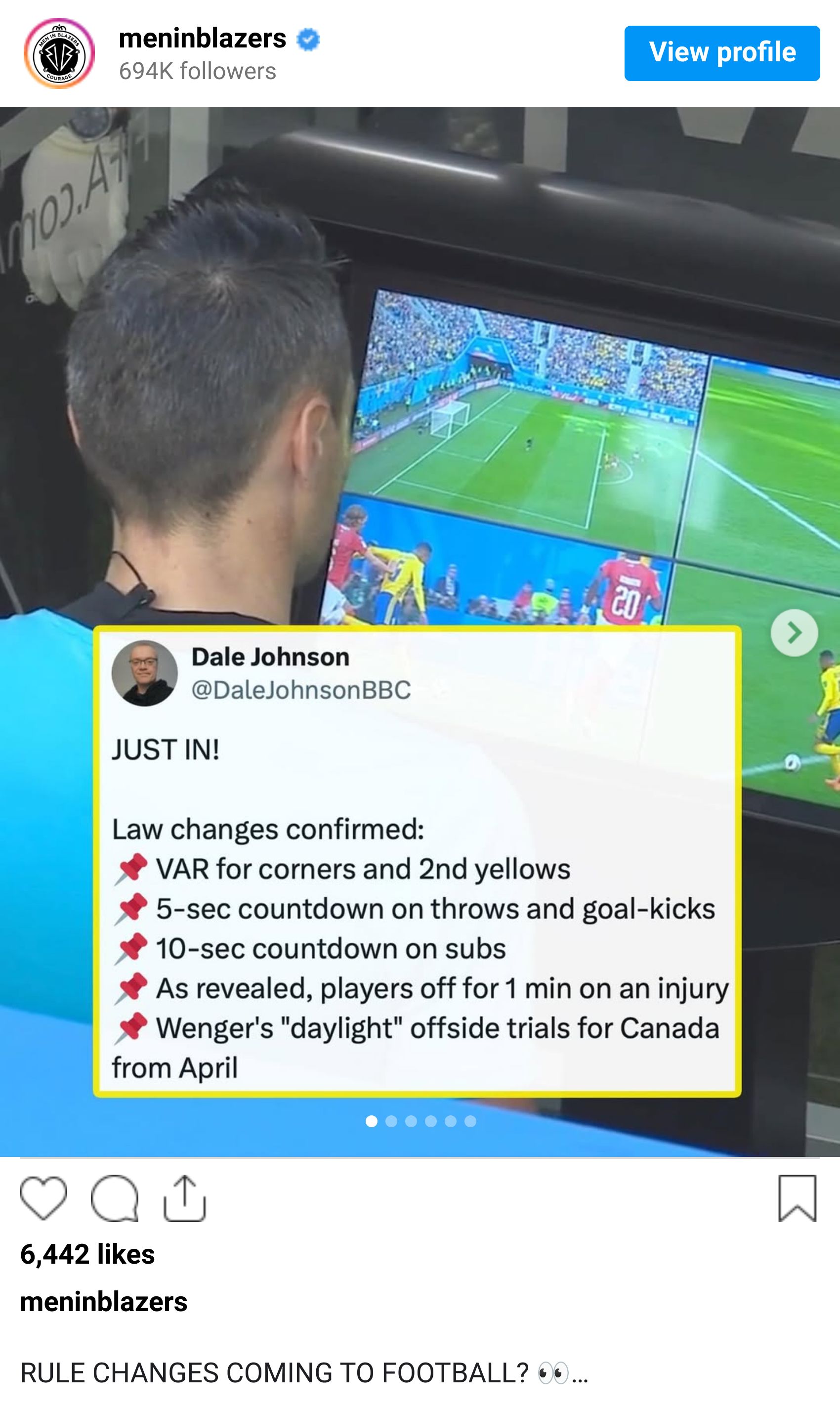
Most of them seem at least faintly sensible. A countdown timer on throw-ins and goal-kicks. A gentle and inherently rational expansion of the definition of what counts as denial of a goalscoring opportunity. Allowing Video Assistant Referees to adjudicate on whether a player’s second yellow card was warranted, in order to minimize the risk of unnecessary sendings-off.
I’ve spoken to a couple of former players, and one former official, and all of them agreed this last one was a good thing. It is, after all, an injustice when a player is wrongly dismissed for a second bookable offense. This amendment is simply an acknowledgment that there was a lacuna – as well as a logical inconsistency – in VAR’s responsibilities.
All of them assured me that, with such limited scope, there could be no downsides. But the thing is: this is how it always starts. How long is it until a player is sent off for a perfectly valid second yellow, only for there to be an outcry over how soft the first one is? Why, if we are to take this to its extremes, is it the second yellow that can be assessed, and not the first?
I have, this season, reached the conclusion that the only available moral position on VAR is to abolish it. The costs outweigh the benefits. But I’m just about smart enough to know which way the wind is blowing. If I understood what Polymarket was, and I don’t, I would be backing there to be another amendment a couple of years down the line, in which all bookings fall under VAR’s purview. That has been the direction of travel for years. VAR is a case study in mission creep. We know this by now.
Reading Material 💻
I wrote about Bodø/Glimt, and why they sort of make me sad.
The best title race (almost) in Europe.
For (British) podcast enthusiasts.
True Crime obsession goes too far.
Armed robberies for Pokémon cards are a thing.
The Watchlist 📺
The last two rounds of the FA Cup have not, if we are all honest, been especially thrilling. But let’s not be too instant gratification about this; part of the allure of knockout competitions is that, at times, they reward a bit of patience. Saturday is a case study, a potential FA Cup classic in waiting: Mansfield Town of League One hosting Arsenal, Chelsea visiting Wrexham, followed by the 84th meeting of Newcastle and Manchester City this season (all on ESPN+ in the U.S.).
Sunday’s slate is not as compelling, but that’s a good thing: it means there’s more time to watch three seismic games from the continent. There’s Olympiacos against PAOK, a game of more layers than a baklava, as well as Benfica trying to rescue what is turning into a bitterly disappointing season against FC Porto, before the weekend’s biggest fixture: the Derby della Madonnina, AC Milan against Inter Milan, and the last chance anyone will have of making the end of the Serie A season interesting (3:45 p.m. ET, Paramount+).
Correspondents Write In ✍️
Last week’s discussion of whether Tottenham might actually get relegated brought what, I believe, qualifies as a plurality of views into the inbox. Alex McMillan suggested Spurs might be the first team to “win the Champions League and be relegated,” which is a nice thought but not an eventuality we should be concerning ourselves with particularly.
Peter Jetton had the same thought, although framed as a question: “What happens if they win the Champions League and get demoted?” he asked. The answer: they play in the Champions League next season as a Championship side, and a substantial number of footballers will have to work out how that makes them feel. It would also, presumably, present Arsenal fans with an even more complex set of emotions.
Chris Roselle, on the other hand, is already starting to rationalize it. “In discussions with some fellow Spurs fans, I brought up the fact that – as an American – this supposed relegation scrap doesn't fill me with as much dread as it does many longtime club supporters,” he wrote. “I wonder if this is due to the fact that…relegation is so foreign to us.”
“While I want Spurs to stay up in the top division, if they play in the Championship next season I really don't foresee it changing my approach to my fandom. I will still support them from afar. Rather than cheering them on early on a weekend morning against Chelsea, I'll cheer for them on a cold Wednesday night in Stoke.”
This is a really interesting aspect of Spurs’ situation, and one that I hadn’t considered. They do have a more sizable international footprint than most of the teams who are habitually fighting against relegation; they have a fanbase for whom the possibility of occasionally being in the Championship is not assumed in the way that it is for Burnley, or for West Ham, or even for Brentford. Chris’ attitude is the right one; my instinct is that most of Spurs’ new(er) fans would be the same, but it would be fascinating to find out. Not for Spurs, obviously. For them, it’s very much an ignorance is bliss scenario.
That’s all for this week. Thank you so much for all of your emails – we read and appreciate them all. Please do keep them coming to [email protected], whether they are questions or quibbles or cathartic exercises in justifying your club’s colossal failures. They’re all welcome.
Have a great weekend,
Rory
🙌 If you’re enjoying The Correspondent, we’d love an assist. Forward this email or share this URL with a friend, family member, or fellow football fan.
📧 First time with us? Sign up here to get Rory’s next newsletter sent straight to your inbox, and be sure to check out our other newsletters too.
Daily news for curious minds.
Be the smartest person in the room. 1440 navigates 100+ sources to deliver a comprehensive, unbiased news roundup — politics, business, culture, and more — in a quick, 5-minute read. Completely free, completely factual.