
Greetings from Yorkshire!
I’m not entirely sure of the exact moment it happened. It might have been Antonín Kinský’s second, heartbreaking mistake. It might have been Lamine Yamal’s last-minute penalty at St. James’ Park. Or maybe it was the following night: Federico Valverde’s extraordinary hat-trick goal, maybe, or Khvicha Kvaratskhelia’s devastating cameo against Chelsea.
Maybe these things are personal. Maybe each of us will be able to point to a different incident, a different goal. Or maybe, more than anything, it was the composite, the effect of all of these things happening in short order, crammed into no more than a couple of hours on Tuesday and Wednesday.
Regardless: whenever and however it happened, this week served as a sort of flexing of the muscles of the Champions League. It sometimes feels as though all we ever do is grumble about what is supposed to be European football’s pre-eminent tournament, complaining about the schedule or the format or the chronic imbalances. As the Premier League has risen, it has been easy to worry that perhaps the Champions League is losing just a little bit of its sheen.
And then, just as they did this week, the competition enters its end game and you’re reminded: even if some things have been lost, there’s really nothing like it.


Familiarity Breeds Content 🏆

Football tends towards nostalgia. The explanation for that has always seemed to me relatively simple: whether we come to it as children or later in life, that first exposure is full of a wonder that ebbs – naturally, unavoidably – over time. Nothing is ever quite as thrilling, as all-consuming, as the first flush of love.
Nostalgia is, for that reason, to be resisted. Not avoided, necessarily, or rejected wholesale, but questioned, interrogated, suspected. The idea that the game is not what it once was, that it could be improved if only it went back to how it used to be, is often not really an assessment of the game at all. It is an expression of our own yearning for youth.
This has been, objectively, an outstanding week of Champions League football. We do not need to linger too long on Liverpool’s or Arsenal’s contributions, admittedly; Bayern Munich’s blowout against Atalanta was an impressive signal of intent, but it might be pushing it to describe it as dramatic. The other five games, though, more than made up for it.
If some of the stories that emerged felt just a touch derivative – Chelsea undone by the team’s naivety; Bodø/Glimt conjuring yet another miracle – others very much did not. Igor Tudor changing his goalkeeper, and then his mind, in the space of 17 first-half minutes: that’s a great twist. Federico Valverde claiming the first hat-trick of his career to down Manchester City, likewise.
Perhaps, then, it is just nostalgia that made me feel as though there was still something missing. Not quality, of course. There was plenty of that. Drama, too, in great bucketloads. It would be disingenuous in the extreme to pretend that this week has produced anything other than entertainment of the highest class imaginable.
What it lacked, though, was pomp, and importance, and that feeling that we were witnessing truly seismic, era-defining events play out in real time. That might well be a trick of the memory, of the light; it might be that the meaning of these games has been diluted, to me, to lots of us, because they are no longer new. We know how the Champions League, even at its best, feels.
Even allowing for that, though, I’m tempted to say there is a kernel of objective truth – rather than emotional subjectivity – in that view. Much of that is to do with frequency. Real Madrid played Manchester City in the group phase. Galatasaray and Liverpool met just a few months ago, too, as did Newcastle and Barcelona.
This is not just inevitable, given the fact that the number of games in the Champions League has been increased as the number of teams who inhabit its latter rounds seems to decrease every year, but close to a deliberate act. UEFA, and Europe’s major clubs, believe this is what fans want: more meetings between the biggest, most popular teams the game has to offer.
That might well be true – I would guess there is research to show that is the case – but the theory and the reality still diverge a little. These games are not as rare as they used to be. That means they do not, and cannot, feel quite as special, quite as generational, as they might have done. Instead, they are just a little watered-down, even with the stakes raised, somehow ersatz. It is no longer a grand occasion. It is just yet more content. That, after all, is what familiarity breeds.
There is a key element in football’s success that has been lost in the sport’s rapid, rampant commercialization: it is, at heart, a game of scarcity. Goals bring a release because they do not happen very often. It is, or it should be the same, with these marquee fixtures, the ones that whet the appetite and mark the years.
Increasingly, that is not true; as my friend Miguel Delaney pointed out on Libero this week, the knockout stages of the Champions League used to follow a two-month hiatus, one in which suspense and tension and anxiety could build. That has long since disappeared. There were Champions League games two weeks ago.
That is better for the bottom line, of course. In an attention economy, football is in no position to absent itself for months at a time. What if people went off and got really into ”Industry,” or decided they’d prefer to play Roblox or whatever? It simply would not do. Even football, the most popular pastime there has ever been, cannot afford to release our eyeballs from its grip.
Whether it is good for the competition is different. Nostalgia is to be resisted. Perhaps this is what younger viewers, more recent converts, like; it is certainly what they will come to consider normal. But there is a part of me, even allowing for all that, which wonders if perhaps we did have it right, in the before-times: that sometimes less can be more, that occasionally, magic and mystery mean more than money.
The Heartbreak 🐺

Wolves’ fans had long since accepted their fate. That their team would be relegated this season was apparent as early as November, when a 10th Premier League game without a win ensured Vítor Pereira’s dismissal. His departure did not improve things: Wolves did not so much as score a goal for another month afterwards.
By the time of my first trip to Molineux this season – for the visit of West Ham – the specter of demotion no longer held quite so much dread. There was snow underfoot; the sun was bright, crisp. The fans seemed light, and free. Their team only had three points. They were obviously going down. There was not much to do but to laugh at the futility of it all. There was no pain, only acceptance.
What everyone should remember, though, is that football has a really cruel streak. Pereira’s replacement, Rob Edwards, has slowly and surely salvaged a little dignity, at least, from the wreckage of this campaign: creditable draws with Everton, Newcastle and Nottingham Forest; a remarkable point against Arsenal; two breathtaking wins against Aston Villa and Liverpool.
So good has the team’s form been, in fact, that it is just about possible, now, to glimpse a road to salvation. The gap to 17th place and salvation is now just 12 points. West Ham, Tottenham and Nottingham Forest all seem vulnerable. Wolves only play two teams in the top 10 in their remaining fixtures: Brentford and Fulham. Nobody believes they can stay up, of course. But one or two might be starting to wonder.
And that is the cruelty of it all, the willful sadism that underlies the game. Wolves will still go down. The club’s fans had suffered that realization. They had, after a while, accepted it. They had come to terms with it. It did not hurt any more. Now, thanks to that brief and illusory glimmer of possibility, they will somehow have their hearts broken again.
The Chant 🎶
We have not, I think, had an outlandish theory for some time. So allow me to air this one: teams not only have more fun but actively perform better when their fans have a specific chant to serve as a soundtrack.
Fans always have chants, of course. Every club has a regular songbook that provides the sonic backdrop to their home games. Many do a version of “O When The Saints.” Pretty much everyone has something based on the hook from “Sloop John B.” A surprising number of teams believe themselves, in the face of all available evidence, to be the “Greatest The World Has Ever Seen.”
It is when a new one is added to that repertoire that something magical happens. That is true everywhere, but the examples that come to my mind are at Liverpool: “Ring of Fire” and “Oh Campione” in 2005 and then, in 2018, “Allez Allez Allez.” All three had the same impact, galvanizing the crowd, electrifying the atmosphere. The best way I can put it, I think, is that people go into the stadium actively wanting to sing, rather than feeling it is a duty. It makes things fresh.
Sometimes, the song in question is directed at a specific player: often not the best player, or the most important, but the one whose name just so happens to fit. Luís Díaz, Diogo Jota and, maybe most obviously, Federico Chiesa have all won places in Anfield’s heart at least in part through its ears in the last few years.
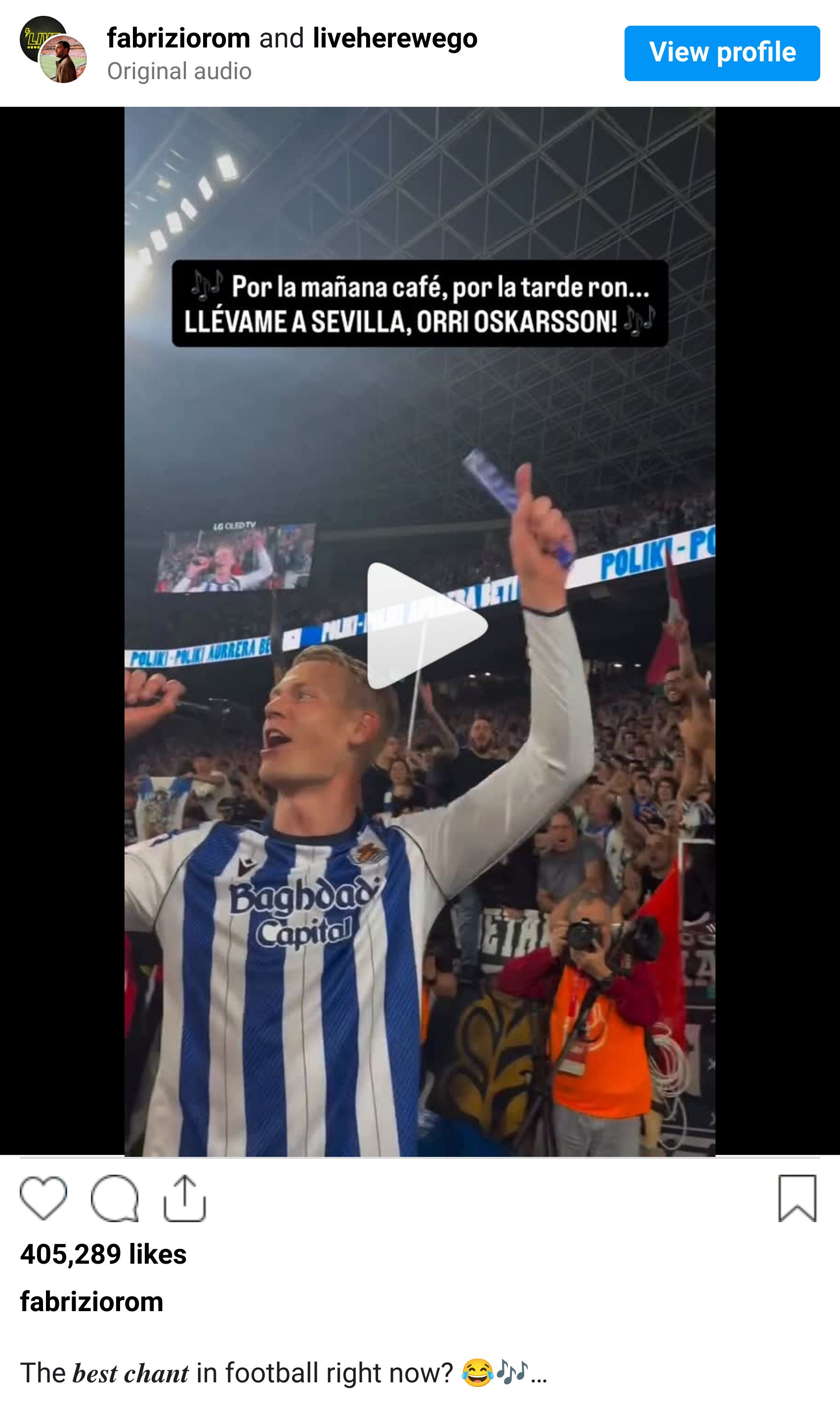
That process is currently playing out – at deafening volume – in San Sebastián. Real Sociedad can, I suspect, lay claim to the best new chant in Europe: a version of Bad Bunny’s “Café Con Ron” that is dedicated to the club’s Icelandic striker, Orri Oskarsson. If you haven’t heard it, I would heartily recommend spending several days doing so. You can expect to hear a cover of it elsewhere very soon. But the original is at La Real, and they will (and should) revel in it for as long as possible.
This Week on the MiB Pod 🎙️
Rog and Rory break down Lamine Yamal’s incredible rise at Barcelona and with Spain and ask the big question: are we expecting too much from a teenage superstar? They also dive into the remarkable consistency of Harry Kane at Bayern Munich, and discuss why Kane’s all-around brilliance might still be under-appreciated.
Reading Material 💻
A dispatch from the frontlines of football’s friendliest derby (contains pintxos).
We are at the stage with set pieces where Something Must Be Done.
In video form: how England’s groundskeepers conquered the weather.
What’s the point of investing in a football club if you’re not filming it?
Well, this is depressing.
The Watchlist 📺
Sunday has the look of a day that might shred a few Premier League nerves. Michael Carrick’s halo at Manchester United slipped just faintly in defeat 10 days ago; his chance to restore it comes against an Aston Villa team that seems to have run out of gas at precisely the wrong moment. Both will see nothing but peril.
The same, oddly, is probably true of Liverpool and Tottenham. Those of us who have written thousands of words saying Spurs will be fine are starting to worry; the situation does not seem to be improving. But Liverpool does not exactly inspire confidence, either. Results have been… OK, maybe, for a couple of months but performances have rarely risen above drab, and that is becoming a real issue for Arne Slot.
Altogether more uplifting might be the game on Saturday between Hamburg and Köln: two of Germany’s traditional big beasts were promoted together last season, and both are still fretting just a little about bouncing straight back down. The atmosphere at the Volksparkstadion is rarely anything less than spectacular.
Correspondents Write In ✍️
I’m not quite sure how I feel about this email from Kevin Kozel. “I don’t recall players deliberately going to sidelines and playing the ball off defenders to earn corners or throws,” he wrote, with regard to the ongoing debate around set pieces and styles of play. “I do recall many defenders ‘safely’ putting the ball out for a throw or a corner though. So why are we up in arms about teams taking advantage of the opportunities they’re given? Isn’t that what they should be doing?”
This is a perfectly reasonable position to take. As Kevin pointed out, perhaps the way to avoid conceding from set pieces is to concede fewer, and therefore keep the ball in play a little more. It’s also the position taken by quite a few of you in response to last week’s newsletter about Arsenal. “Corner kicks and attacking free-kicks are the result of a strong attack,” Carl Lennertz pointed out. “So all credit to an aggressive team. I don’t understand the fuss.”
Besides, as George Walter said, sometimes the destination is more important than the journey. “I will not care how they deliver a title, when they do deliver it,” he wrote. “My 17-year-old son has never felt the joy. I am most excited for him. I think all fans would feel the same about their team. The tough part is admitting it.”
The reason I am conflicted about Kevin’s email in particular is that it arrived before last week’s edition had been sent out. It may even have arrived before it was written. At best, this means that I am entirely too predictable. At worst, it means Kevin has sort of “Minority Report”-ed my brain, which is a very worrying situation indeed.
That’s all for this week, while I figure out if the emails from Kevin are coming from inside the house. Have a great weekend. Enjoy all those corners!
Rory
👋 As always, you can send any feedback, thoughts, or odes to Terry’s Chocolate Oranges to [email protected].
🙌 If you’re enjoying The Correspondent, we’d love an assist. Forward this email or share this URL with a friend, family member, or fellow football fan.
📧 First time with us? Sign up here to get Rory’s next newsletter sent straight to your inbox, and be sure to check out our other newsletters too.
Daily news for curious minds.
Be the smartest person in the room. 1440 navigates 100+ sources to deliver a comprehensive, unbiased news roundup — politics, business, culture, and more — in a quick, 5-minute read. Completely free, completely factual.