
Greetings from Rome!
Well, we are at least going to have to recognize the possibility that Mohamed Salah reads this newsletter. Last week, I wrote about how few players and managers have the privilege of choosing how, and more importantly when, to say goodbye. Football is cruel enough that even the very best – Salah, Pep Guardiola – cannot always choose the circumstances of their departures.
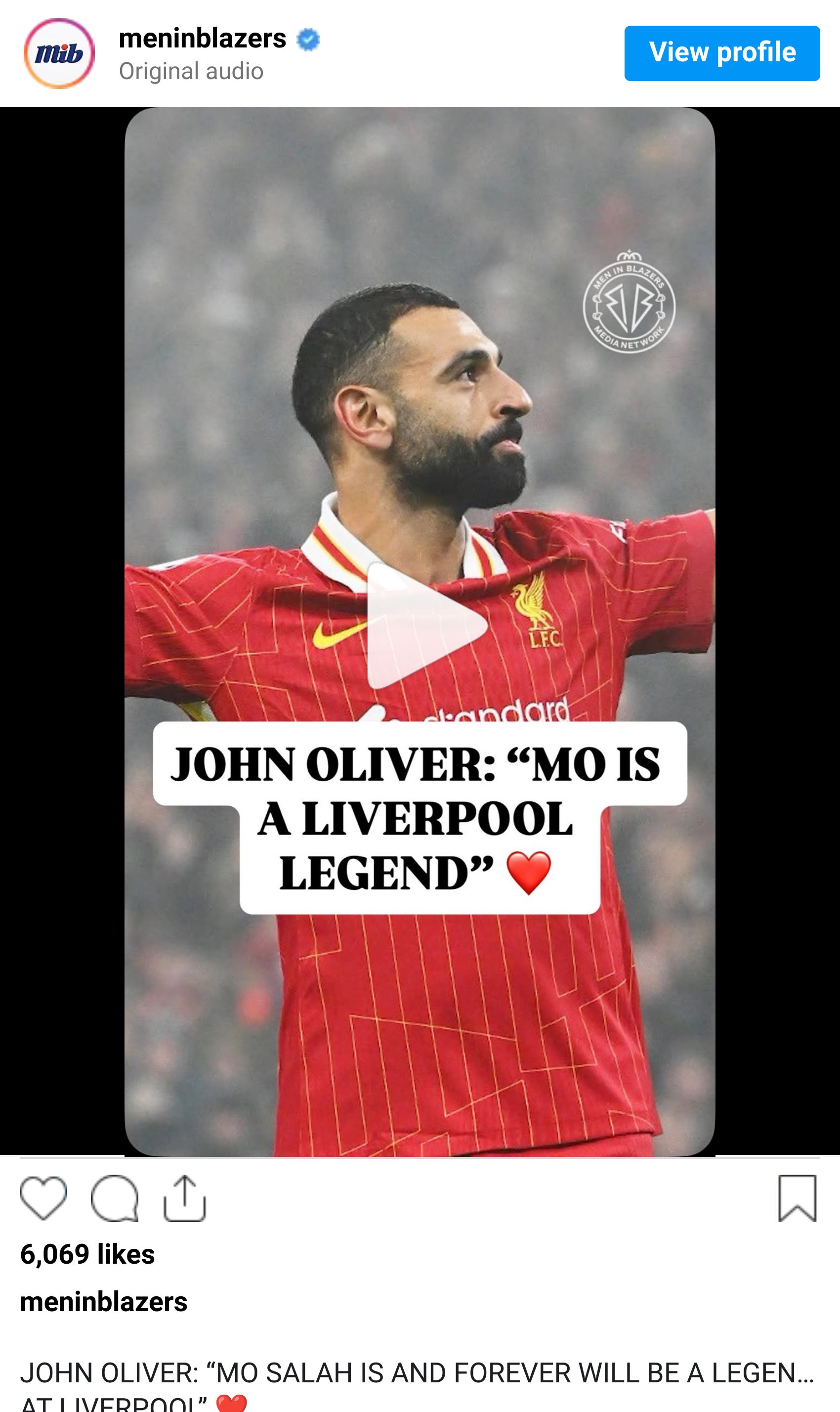
And then on Tuesday, as you will probably have noticed, Salah announced that we are now entering the final two months of his nine years at Liverpool. This season has not been quite as glorious a valedictory tour as the Egyptian might have hoped; nothing short of a distinctly unlikely Champions League win will change that.
In going public, though, Salah could at least take some measure of control over the response to his exit. He could time it as best he could: after his best performance of the campaign, against Galatasaray, and with two months for Liverpool’s fans to pay him the tributes he so richly deserves. So soon after last week’s edition of this newsletter, is that a coincidence? Yes. It is absolutely a coincidence.


The World Cup Needs Italy 🇮🇹

The word was so good that Riccardo Calafiori used it twice. On Thursday, Italy faces Northern Ireland in Bergamo in what is probably easiest understood as a World Cup qualifying semifinal. The four-time world champion has to win that, and then beat Bosnia or Wales next week, in order to take its place in North America in three months’ time. It is, Calafiori repeated, a “delicate” moment.
That is not just because of the scale of the prize on offer from these two games, of course. In a way – and this should not be read as a slight on any of the teams standing in Italy’s way – Gennaro Gattuso’s side’s greatest opponents will not be the ones lining up against them. It is the ghosts that will accompany them every step of the way. Italy’s players are going to have to beat themselves.
By any measure, Italy ranks as a first-rate football power. Let’s stress it again: four-time world champion. European champion as recently as 2021. Home to one of Europe’s big five leagues, a handful of the world’s richest clubs, and one of its most influential, most compelling, most spectacular football cultures, both on the field and off it.
And yet, should Calafiori and his teammates fail over the next few days, Italy would have missed three straight World Cups. Their predecessors stumbled in a playoff against Sweden that cost them a spot in 2018. A defeat to North Macedonia – I’d make a joke about it not even being all of Macedonia, but that is a very sore subject so it’s probably best to refrain – in Palermo meant Qatar 2022 happened without the then-European champion. Falling short again would be an almost unfathomable national humiliation.
As you would expect, there has been no shortage of explanations as to why this might have happened, why it might continue to happen. Gattuso’s presence alone hints at one of them: Italy has long been accused, by its fans, of lacking the requisite passion and intensity. More convincing is the idea that successive generations of players have failed to cope with the pressure of representing the national team; or, more accurately, they have crumbled when faced with the prospect of embarrassment.
Rarely mentioned – because football, in Italy as it is everywhere, is inherently inward-looking; it forgets, habitually, that the other team is also trying to win – is the fact that the old hierarchies no longer really apply in Europe.
Norway, who beat Italy to the automatic spot in qualifying for this summer’s tournament, is a case in point: nations traditionally regarded as second-rank can now happily produce a team, or a squad, of just as much talent and technical ability as those crafted by the game’s traditional superpowers. The same has been true of Portugal for 30 years, and Croatia for 25, and Belgium for 20. The bar keeps rising. Size is no longer a guarantee of quality.
The most important factor, though, is one of Italy’s own making. Almost 10 years ago, James Horncastle and I sat down with Massimiliano Allegri – formerly of Juventus, now coaching AC Milan – and listened to him explain how Italy does not produce “champion” players any more. That was, perhaps, a bit of an exaggeration, but it contained a kernel of truth.
The youth systems of England, Spain and France churn out prodigies at an almost industrial scale. Italy’s sputters, at best. They might get a Nicolò Barella or Sandro Tonali occasionally, but not in anything like the numbers required to populate Serie A or to elevate the national team. Instead, Italian youth football is geared around producing the country’s greatest sporting export: coaches.
It is possible, then, that it is in Italy’s interest to miss out on another World Cup. It might concentrate a few minds, force the country’s creaking and ancient football establishment to confront its own shortcomings, to start to find a way to rethink the way it makes footballers. Maybe, in the long run, necessity can be the mother of invention.
The problem is that the cost, to the rest of us, would be severe. (This line of thinking will not be popular in Wales, Northern Ireland or Bosnia, and for that I can only apologize.) One strand of the World Cup’s appeal is its romance; it is impossible not to be excited by the prospect of seeing Curacao, Uzbekistan and Jordan at the tournament this summer, each of them making their debut.
The same would be true of basically all of the teams taking part in the intercontinental playoffs in Mexico this week, and several of the European contingent who still harbor hopes of making it. The wonder of being at the world’s biggest, greatest sporting event lifts these countries; in doing so, they imbue the World Cup with some of its meaning.
But there is another side to it, too, one which is a little more hard-nosed, but no less legitimate. The World Cup carries more weight, more gravitas, more prestige if the game’s heavyweights are all present and correct. Italy easily falls into that bracket. The World Cup loses something – a little something – if Italy is not there.
That is especially true, I think, given the tournament’s expansion. It is one of the positives of shifting to a 48-team model that more nations have been able to qualify for the first time. It emphasizes the romance, enhances the allure. But the World Cup also draws some of its appeal from its history, and Italy is an indelible part of that. It has faded, of course, perhaps irreparably, but the old grandeur has not been erased, not entirely, and it still has just enough power to illuminate the tournament as a whole.
Human ❤️

To return, briefly, to Salah’s announcement: one line in the public statement he issued stood out more than all of the others. Among the expressions of gratitude and affection for his teammates, his coaches and Liverpool’s fans, the Egyptian noted that he and his teammates had “fought through the hardest time in our life together.”
That is, of course, a reference to what remains the defining event of Liverpool’s campaign; what may be, in fact, the event that comes to define not just these players’ relationship with Liverpool as a club, but this stage of their careers: the death of Diogo Jota.
Like quite a lot of journalists, pundits and fans, I was adamant after Jota’s passing that Liverpool should effectively be given a free pass for this season. What they had been through, what they were facing, rendered whether they could retain their title or win a trophy essentially meaningless. As Caoimhin Kelleher has said, for much of Arne Slot’s squad, and for Slot himself, the challenge was simply to come to terms with it.
There have certainly been times when I haven’t been able to live up to that aspiration, when I have fallen into the trap not necessarily of forgetting the broader emotional context to the season but perhaps of not affording it sufficient weight.
Salah is not the first of Jota’s teammates to offer us a brief, subtle reminder of just what Liverpool’s players have been – and are still – going through. Although the club’s policy has always been not to discuss it in public, out of respect for his family, Virgil Van Dijk and Andy Robertson have alluded to the challenge the squad has faced. Salah, though, is perhaps the first to make clear just how hard it has been. We should recognize and respect that. I should, certainly.
This Week on the MiB Pod 🎙️
Rog and Rory broke down a truly chaotic Premier League weekend where dreams evaporated, crises deepened, and Pep danced again at Wembley. Tottenham are in full-blown relegation trouble after a humiliating loss to Nottingham Forest. One point above the drop… how did it get this bad for Spurs, and can they survive? And Everton delivered a statement win over Chelsea as Goodison Park energy returned at Hill Dickinson. Will David Moyes really achieve his European dream and what is going wrong at Chelsea?
Reading Material 💻
Managers are the most important of the least important things
A reflection on Mikel Arteta’s real masterpiece: making AFTV happy
Brian Phillips on the price of oil
Jacket potatoes are trendy now
The amazing Amanda Mull on “Monitoring the Situation”
The Watchlist 📺

OK, so this one is quite tricky. You’re reading this on the day that the last few playoffs – the intercontinental tournament being held in Mexico, and the European repechage being staged everywhere from Cardiff to Istanbul – will begin; that means, and I do not wish to offer too much of a peek behind the curtain, I am writing this before any of this stuff has happened.
It’s slightly tricky, then, to try to recommend what you should watch. All of it, maybe? I would guess the games in Mexico will be DR Congo against Jamaica and Iraq facing Bolivia, which are just wondrous combinations of names, but I would not pretend I have the slightest clue if New Caledonia are any good or not. They might be amazing.
And then there’s Europe, where in addition to Italy’s psychodrama, all but one of the “pathways” seem wonderfully finely-poised. Türkiye seems well-placed to make it through a section that contains Slovakia, Kosovo and Romania, but the others are almost impossible to predict. That is the appeal: the standard may not be the highest, but the stakes more than make up for it.
Correspondents Write In ✍️
This week brought a very pleasing mix of subjects into the mailbag/box, although if there was a signal in the noise, it was that people are VERY invested in the relegation battle. I have the same feeling: Spurs’ defeat at the weekend felt to me like the main event, with the Carabao Cup final sort of relegated to second place.
First up, then, a question from Lou Bunnick. “I’ve always thought of Wolves as the wrench in the works – the spoiler, making sure others can’t have nice things. As an Everton supporter, Wolves were the team I feared most in the run-in, when we were trying to stay up. They are going to be the team to watch in April: West Ham, Leeds and Spurs on the docket. That’s a lot of wrenches. But who, in your opinion, is the spoiling-est spoiler?”
This is one of those subjects that will, I suspect, be defined by your own team’s experiences: my first instinct is that the true spoilers – the team that turns up and wins not for personal gain but out of pure gleeful malice – of the Premier League are very obviously Crystal Palace. Sitting there in mid-table, nothing to play for, casually deciding to play Liverpool off the park.
The other team that seems to me to fit the bill would be Fulham, who also tend to spend most of the second half of the season with little at stake beyond crushing everyone else’s dreams, but I’d be fascinated to know if fans of other clubs perceive them in the same way. Maybe we all have our own party-poopers.
“A couple of years ago, I decided to commit to following a PL team,” Grant Downes tells me, “and both arbitrarily and for some random reasons chose Nottingham Forest. I don’t relish the thought of trying to follow them in the Championship next season, but I will if I have to. Their remaining schedule isn’t overly favorable. Aside from Burnley, what other games do you see them picking up points? And in the long run, what can help bring stability to the club?”
There’s an optimistic and pessimistic answer to this question. The optimistic one is that Forest still have to play Burnley, Newcastle and Bournemouth at home, and the City Ground can be extremely hostile territory. Even the home game against Villa, after the first leg of the Europa League quarterfinal, might be rather more promising than the table might suggest.
The pessimistic one, of course, is that this Premier League season has been almost entirely arbitrary and there is every chance Forest do not win a single one of those games; at this stage of the campaign, when the pressure is on some teams and off others, previous form is not nearly as useful a guide as we might like. My instinct, though, is that the win at Tottenham has a greater significance than just three points.
That’s all for this week. Enjoy the wonders of the international break, and if any thoughts occur to you while you’re watching New Caledonia or Slovakia or whatever, please send them here. All of your ideas, questions and quibbles are much appreciated.
Take care,
Rory
🙌 If you’re enjoying The Correspondent, we’d love an assist. Forward this email or share this URL with a friend, family member, or fellow football fan.
📧 First time with us? Sign up here to get Rory’s next newsletter sent straight to your inbox, and be sure to check out our other newsletters too.
👋 As always, you can send any feedback, thoughts or odes to Terry’s Chocolate Oranges to [email protected].
Daily news for curious minds.
Be the smartest person in the room. 1440 navigates 100+ sources to deliver a comprehensive, unbiased news roundup — politics, business, culture, and more — in a quick, 5-minute read. Completely free, completely factual.