
Greetings from Yorkshire!
And just like that, it’s here. Given their size, it’s really quite impressive how World Cups sneak up on you. We’ve been anticipating the world’s arrival in the United States, Canada and Mexico for three and a half years. It has hovered on the horizon, growing ever larger, for months. Somehow, though, the fact it is a week away feels almost feels like a surprise.
I was in New York for a couple of days earlier this week recording our Men In Blazers preview content for the tournament. Nothing illustrates just how massive this whole thing is going to be, quite like trying to get your head around the dreams and fears and ambitions of every single one of the 48 participating teams.
But the thing about the World Cup is that it is only partly about football. This will be my seventh edition, on my fourth continent, and looking back very few of the memories that have stayed with me involve a pitch, a ball, or people standing around taking throw-ins. Thankfully, given some of the prices, they often don’t involve buying a ticket, either.


The World Descends 😅

A couple of months ago now, the office of Quinton Lucas, the mayor of Kansas City, Mo., received a phone call. On the other end of the line was a representative of the KNVB, the body that runs Dutch football. They had a request to make. They wanted the mayor’s help in procuring a street big enough to park a bright orange bus, and several thousand dancing fans.
Ever since the 2026 World Cup was awarded to the joint North American bid in 2018, the tendency has been to present it as one of two things. The first is a sort of coming-out party: a chance for the United States, in particular, to demonstrate to the rest of the planet quite how fully it has embraced the sport in the 32 years since the tournament last landed on its shores.
The other – one that has, perhaps, been more widespread outside the principal host nation – is almost its polar opposite. Football as a whole has a fixation on conquering America. In some cases, that is driven by commercial imperatives; in others, it borders on the evangelical. It’s always felt to me, just a little, like the game either craves American approval, or perhaps resents American resistance.
Either way, there are plenty who have come to view this tournament as a sort of secondary assault on the country’s psyche. It is, in a way, a rerun of 1994: a chance for the game, now armed not just with Diana Ross and Roberto Baggio but with the full cultural armory of retro clothing, saturation media coverage and a bottomless supply of memes, to claim its final frontier.
Both of these are, in their own way, true. This World Cup will, I think, illustrate the extent to which football has permeated the U.S.; it will also offer an opportunity to cement its place in the country’s sporting landscape. But neither captures what may well be the most immediate, most lasting impact: the United States (and Canada, to some extent) discovering just how big the World Cup is.
That is not something that can be adequately expressed through advertising slogans or the triumphalist speeches of excited officials or even the carnival barker sales pitch of Gianni Infantino, the FIFA president. There is a point at which the endless stream of superlatives starts to wash away anything approaching meaning.
It is not even something that can be glimpsed in the way the tournament has been both politicized and promoted. The grandeur of the World Cup is not best illustrated through the enthusiasm with which it has been embraced, somewhat improbably, by the Trump administration, or how much FIFA have decided to charge for tickets. In many ways, both of those misunderstand what it is that gives the World Cup its scale.
Instead, what makes the World Cup the world’s single greatest mega-event – a quadrennial global cultural phenomenon that does not really have any equal: certainly not the Super Bowl, and maybe not even the Olympics – will be seen on the streets, rather than in the stadiums, of the host cities.
It will be there in Kansas City, when the traveling Dutch fans march to the game behind their party bus, shipped across the Atlantic for the very purpose of leading the parade. It will be there in the tens of thousands of Argentines who make their way to the U.S. whether they have tickets, or can afford it, or not.
It will be there in the sight of bright pink Scots wearing thick woolen kilts in the blistering heat of the Florida summer, and flares burning surrounded by jubilant Moroccans, and in the outpourings of support from every single one of the diaspora communities that now call the United States and Canada home.
Nothing moves people around the planet quite like the World Cup; it functions a little bit like a secular pilgrimage, an event that fans feel compelled to attend. That has always been true, but it has become more and more pronounced, more and more fervored, as we crave the emotion and the sensation of human connection in our dissociated digital reality.
But it is one thing hearing that or believing that or knowing that and it is quite another to see it walking down a street in your city, everyone wearing the same color, moving in unison as EDM blasts out of a specially-converted vehicle that has been sent across an ocean for that specific purpose.
I’ve always found that impact is not diminished by familiarity. I remember watching the opening game of South Africa 2010 from a fan park in Soweto, in a crowd of 10,000 people. I remember walking down Nikol'skaya, in Moscow, eight years later, seeing flags and jerseys of every nation blend into one another. I remember sitting at the intersection in Doha’s souq, its traditional marketplace, and seeing vast crowds of Ecuadorians and Mexicans and Tunisians. And Argentinians, of course. Always so many Argentinians.
This World Cup will, I think, convert a few Americans to the joys of soccer as a sport. It will, I’m pretty sure, showcase to the rest of the planet just how much it has grown in the country in the decades since 1994.
Whether that has any lasting, meaningful consequence I have no idea. The World Cup does not change its hosts in the ways that the bid brochures pretend. The stadiums, in previous tournaments, have been left as white elephants. We can say with some certainty it did not lead to any great détente with Vladimir Putin’s Russia. The calls for change in Qatar’s migrant labor laws have been quiet since the circus moved on.
What it does leave, for the people who were there, are memories. And memories change people. Sometimes those memories feature fields and balls and the world’s best players taking throw-ins. But more often than not, they are of the world descending, jubilant and euphoric and often quite drunk, to this place you know, driven by this thing you cannot help but understand.
All Change 🥲

The call Arne Slot received a few hours before the Champions League final – the one that harshly and inevitably, in almost equal measure, turned him in an instant into a former Liverpool head coach – completed the set. Five of the Premier League’s traditional big six have now changed their manager in the last two months.
Quite whether that grouping continues to make sense, given that Tottenham Hotspur keeps finishing 17th, is a different matter. Spurs now seem like a historical anomaly. It might, at the very least, be time to expand the pack, so that the Big Six extends to take in Aston Villa and we start to think of a Lucky Seven.
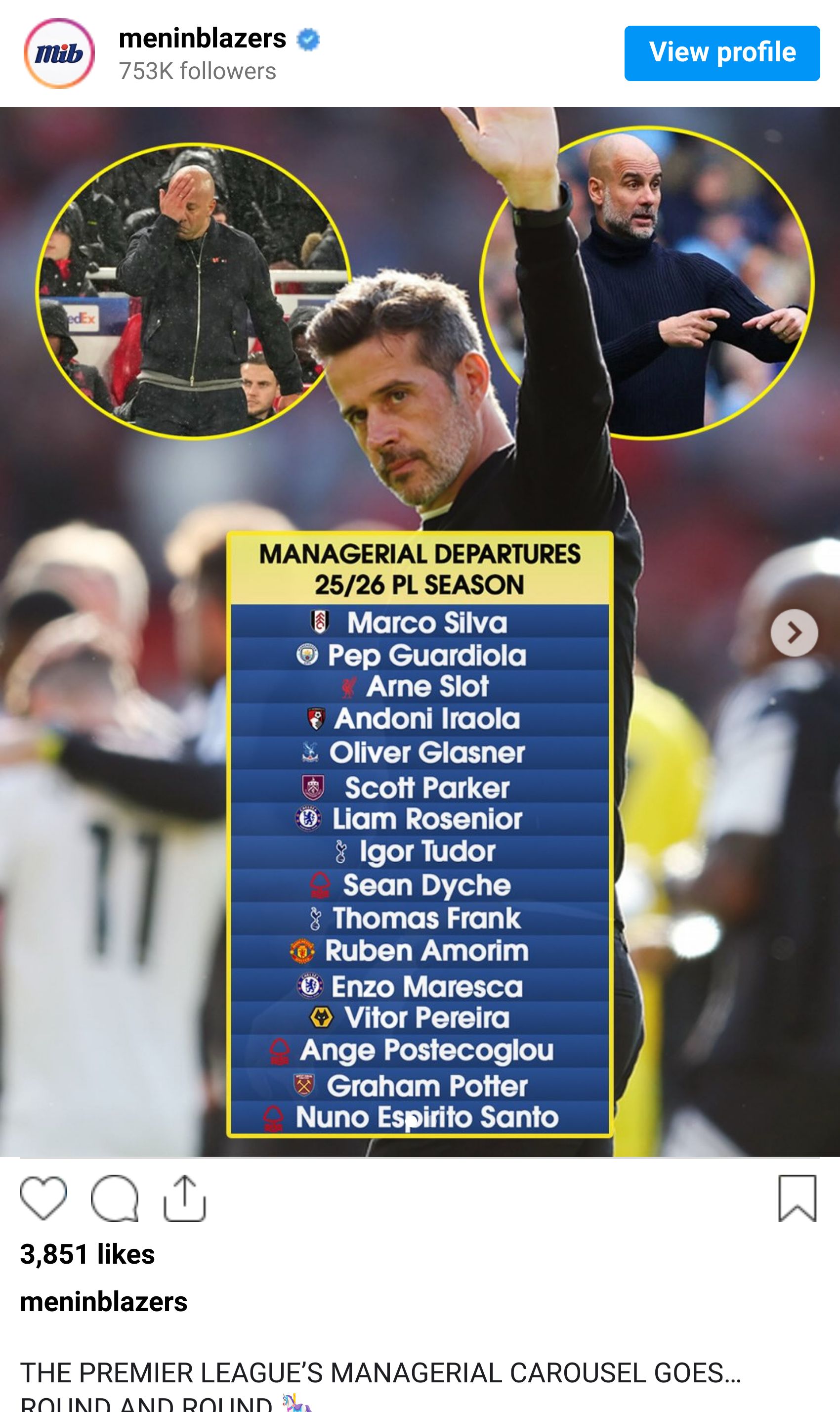
Still, the scale of the change at the league’s (theoretical) summit is telling in any number of ways. Liam Rosenior’s demise showed the extent to which the role of the manager has been downgraded; his replacement with Xabi Alonso illustrated the pull of the Premier League.
Michael Carrick’s coronation at Manchester United showed how selecting the right person is not a simple matter of picking the best CV. And Slot’s departure – replaced, after an exhaustive search that lasted as many as three days, by Andoni Iraola – is a reminder of just how little sentiment, from both fans and executives, the Premier League now holds.
It is only a year since the Dutchman won the Premier League. He had to contend, in his second season, with extraordinarily, tragically difficult circumstances. But by the end, Liverpool did not have much of a choice. Keeping him would have not just been counter-intuitive, but self-destructive. Football demands such continual instant gratification that patience is no longer really an option.
Reading Material 💻
The Champions League seems to have a real taste for torturing Arsenal.
PSG, on the other hand, is now in an undeniable era.
I’ve read a lot about the rise of UFC for research, and this is especially great.
A searingly personal piece of writing from the great Chris Jones.
Paywalled, but Ken Early is the best football writer in the business.
The Watchlist 📺
A week. That’s all that remains before what is definitely the biggest, almost certain to be the most expensive and might just end up being the best men’s World Cup of all begins in Mexico City. All 296 competing teams have named their squads; they all have somewhere between zero and two tune-up games remaining to iron out kinks, sharpen patterns of play and work out who is going to block off whom at corners.
That means there are some pleasingly random games over the weekend, several of them conjured thanks to football’s longstanding logic that all Scandinavian or Mediterranean or African or whatever teams must play exactly the same way. Obviously Nigeria is a good cipher for Algeria. Stands to reason. They share a landmass. They both end in “geria.”
Some are genuinely intriguing in their own rights, though. Having beaten Senegal, the United States will be looking to compound Germany’s psychological disorder on Saturday, a few hours before Brazil takes on Egypt. And then, on Sunday, a game that would make quite a good quarter-final, with Morocco playing Norway. I think, here, that Morocco is cosplaying Senegal and Norway is being deployed as a false Scotland. I’m not sure this is the most flattering logic for, well, anyone.
Correspondents Write In ✍️
We have a philosophical quandary this week, posed for us beautifully by Mike Fernandez. “Does Mikel Arteta’s Arsenal play the way it does because they have to or because they want to? Employing a play-not-to-lose style seems below a big club like Arsenal, and a supposedly quality coach like Arteta. And their side-show tactics should be beneath them.”
I have to be honest here: I don’t have a problem with how Arsenal played against PSG. I don’t love the time-wasting – not being allowed to take a corner at the end of the first half was both fitting and funny – but it would be naive in the extreme to try and take anything other than a cautious approach against a team as gifted as PSG. It is Arteta’s imperative to win; that was his best shot.
That said, the issue of Arsenal’s style is a live one. The argument that economics have forced Arteta’s hand makes sense to an extent: he (correctly) determined that the key ingredients in winning the title are depth and robustness; because Arsenal does not have the resources of a nation state, that inevitably means sacrificing a little quality, especially in attack.
But other teams have responded to similar financial situations and found a more aesthetically pleasing solution; that makes it hard to believe that Arteta’s style is not at least to some extent a choice. We will find out soon enough if it’s not: he said after defeat in Budapest that the club has to be more ambitious in the transfer market if it is to conquer Europe. Better forward players should mean more adventure, more élan. Shouldn’t it?
And we’ll close this week with a programming note: this will be the last edition of The Correspondent for the duration of the World Cup. The Men In Blazers newsletter will be going daily for the tournament, and I’ll be contributing my thoughts on the games, teams and American dessert options there (so make sure you’re subscribed!) But don’t worry – if you were worrying, maybe you weren’t – I’ll be back in your inboxes once Jordan Henderson’s England have finished their bus parade.
Enjoy the tournament. It will, despite it all, be fun.
Take care,
Rory
🙌 If you’re enjoying The Correspondent, we’d love an assist. Forward this email or share this URL with a friend, family member, or fellow football fan.
📧 First time with us? Sign up here to get Rory’s next newsletter sent straight to your inbox, and be sure to check out our other newsletters too.
👋 As always, you can send any feedback, thoughts, or odes to Terry’s Chocolate Oranges to [email protected].